Beyond the Tool
AI adoption works better when mission, people, process, governance, and human judgment come before the technology.
Read Issue 001Short, useful perspectives drawn from years of delivering modernization and transformation inside complex organizations.
A lot of what gets posted on LinkedIn disappears after a day or two. This is where that work lives instead: full articles, a free ROI checkpoint tool for building the internal case for AI training, and a starting checklist you can take with you before you are ready to talk to anyone.
Everything free is actually free. Nothing sits behind a wall you did not expect, and the paid work (the Resource Library) is clearly marked as paid work.
Practical insight on AI, modernization, governance, execution, and organizational change.
AI adoption works better when mission, people, process, governance, and human judgment come before the technology.
Read Issue 001AI is moving fast. Nearly every organization is now asking some version of the same question: how do we actually use this, well, safely, and in a way that helps our people instead of confusing them?
Cutting a five-page resume down to two pages sounds like an editing problem. It is not. It is a judgment problem.
An OCI is not a judgment about your integrity. It is a structural question: does your position in the work make fair competition harder, or make your judgment harder to trust?
Three documents decide whether you keep what you earned, and the order matters.
Nobody tells you that asking for training money is its own skill.
AI is moving fast. Nearly every organization is now asking some version of the same question: how do we actually use this, well, safely, and in a way that helps our people instead of confusing them?
The honest answer is that using AI responsibly and effectively in real work takes more than learning a few prompts. It requires clarity about where AI can genuinely help, where human judgment has to remain central, how to protect sensitive information, and how to build workflows people will actually adopt, not just tools they'll try once and abandon.
That gap, between AI curiosity and AI competence, is where most organizations are stuck right now. Leadership knows something needs to happen. Staff are experimenting on their own, inconsistently, without shared standards. And the distance between "we should probably do something with AI" and an actual, working plan keeps growing.
This is not a coding course, and it isn't a lecture series either. AI Adoption in Practice is a four week live online learning experience built for professionals who want to move past curiosity into practical, confident application, without losing sight of the people, mission, and decisions that actually matter in their work.
The format is intentionally small and hands on. Each cohort is limited to eight to twelve participants, which means real dialogue instead of a one way presentation. Over four live weekly sessions, participants work through real use cases from their own jobs, build responsible habits they can actually sustain, and figure out, together, where AI can support their work without displacing the judgment that only a person can bring.
This distinction, between AI as a tool that extends good judgment and AI as a shortcut that replaces it, sits at the center of everything covered in the program. It's also the same distinction that shaped a six stage, human in the loop AI governance pipeline built for a $150 million federal modernization portfolio, the kind of structure that reduces risk without slowing teams down. That same discipline, translated for organizations of any size, is what this cohort is built around.
Four weeks isn't long enough to make anyone an AI expert, and that isn't the goal. It is long enough to build real clarity and real habits. By the end of the cohort, participants have:
The first cohort is being kept intentionally small so there is room for real dialogue, practical application, and direct support, not a webinar where questions go unanswered in a chat window.
Every week that passes without a shared, responsible approach to AI is a week where individual staff members are making their own decisions about what's safe to share, what's worth trusting, and how to use these tools well, without any shared standard to guide them. That inconsistency is where real risk lives, not in the technology itself, but in the absence of a considered approach to using it.
This cohort exists to close that gap before it grows any wider. If this is something your organization has been circling for a while, now is a reasonable time to stop circling.
For years, the standard advice for a federal resume was simple: write more. Four pages, five pages, sometimes six, packed with every duty and detail you could fit, because more information meant a better shot at getting referred.
That advice is now actively working against people. USAJOBS now blocks resumes longer than two pages outright, not as a style preference, as a hard system rule. A resume built the old way does not get a lower score. It does not get read at all.
That single change has quietly left a lot of strong candidates applying with a document the system will not accept.
Cutting a five-page resume down to two pages sounds like an editing problem. It is not. It is a judgment problem.
The five-page version usually holds the full, honest picture of someone's career, every role, every responsibility, every accomplishment worth mentioning. That full picture still matters. It is the foundation everything else gets built from. But foundation and finished document are not the same thing, and the skill that separates a resume that gets referred from one that does not is knowing exactly which parts of that full career story earn a place on two pages, and which parts, however true and however impressive, have to come out.
Getting that right takes more than trimming sentences. It takes knowing the actual announcement a person is applying to, matching language deliberately instead of generically, and understanding what a federal HR specialist is actually scanning for in the first pass.
I spent nineteen years leading complex programs across federal agencies, including supervisory and program analyst roles at the GS-14 level. That is not the same as having read a book about how federal hiring works. It means having lived the actual language federal HR specialists look for, because I used to write performance documentation and program reporting in that exact language myself.
That background is what a resume-writing certification alone cannot replicate. A federal resume is not a formatting exercise. It is a translation exercise, translating a real career into the specific words an announcement is built around, without losing what made that career worth hiring in the first place.
Federal hiring has changed in more than one way recently, not just the two-page limit. Positions at GS-05 and above now require four short written responses as part of the application, and applicants must certify those responses are their own words, without AI assistance. That is a real, current rule, and it means the resume and the rest of the application need to be handled with real care, not run through a generic AI tool and submitted as is.
Every resume built through this service is grounded in the current OPM format, tailored to the specific announcement a client is targeting, and reviewed by hand before it goes out. Nothing gets submitted without a person checking every field, every keyword, and every detail against what the announcement actually asks for.
The process starts with a short, no-cost conversation about the target role and timeline, then moves into a resume built specifically around the announcement provided, not a generic template stretched to fit. Turnaround runs a few business days for most grade levels, longer for senior roles, with a faster option available when timing is tight.
The old five-page resume was not wrong when it was written. It was simply built for a system that no longer exists. What replaces it has to hold everything that made the long version strong, judgment, evidence, real language, in a document a fraction of the length. That is the part worth getting right.
It has nothing to do with your price or your proposal. It is called an organizational conflict of interest, OCI for short, and it is the clause that catches more small businesses off guard than almost anything else in the FAR.
An OCI is not a judgment about your integrity. It is a structural question: does your position in the work make fair competition harder, or make your judgment harder to trust? Contracting officers have to answer that question before an award, and they would much rather answer it early than unwind it later.
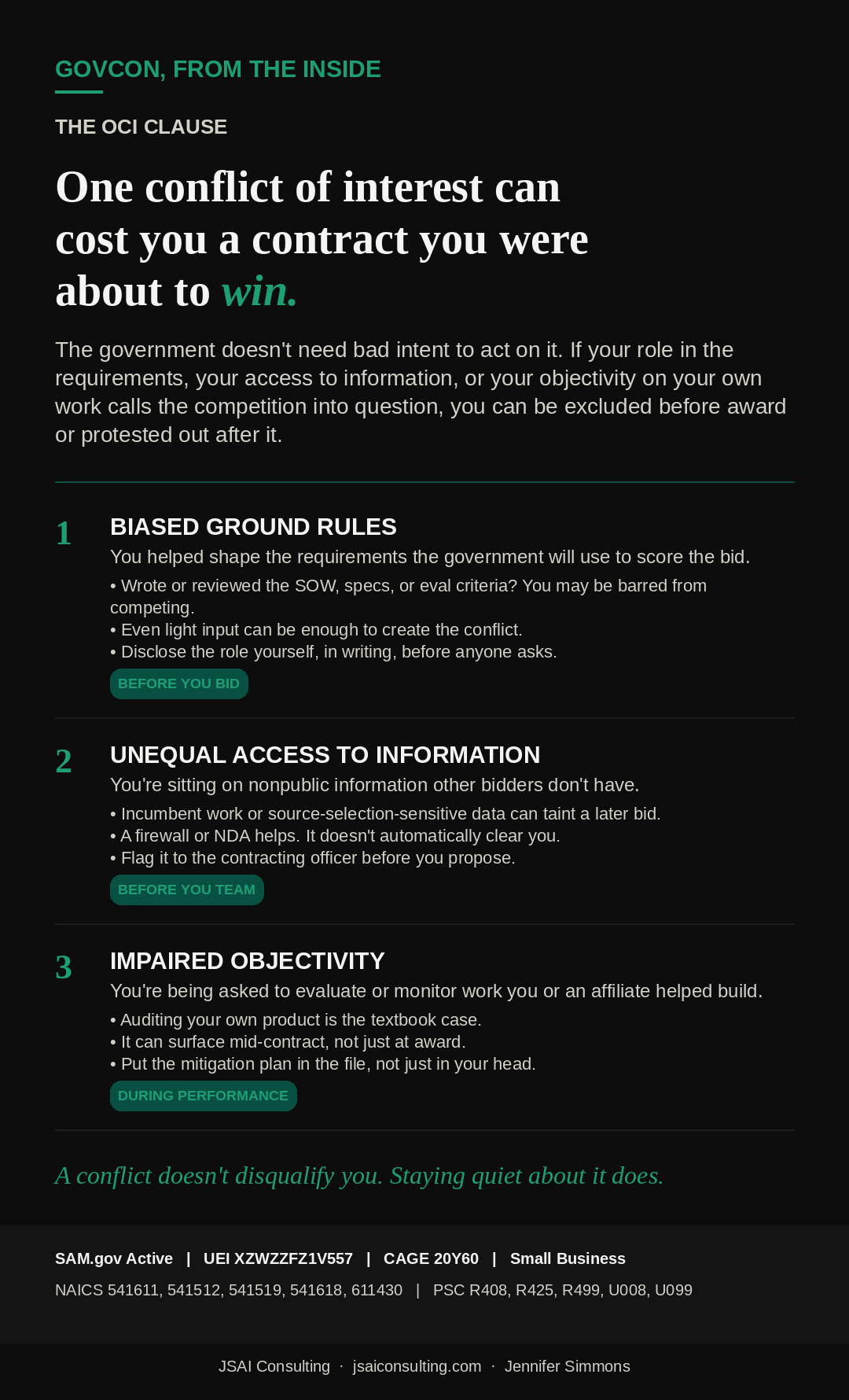
Most OCIs can be mitigated. Firewalls, subcontracting the affected scope, or narrowing your role can all work, and contracting officers approve mitigation plans regularly. What they cannot forgive is finding out on their own, after the fact, that you knew and said nothing.
Disclose early, in writing, and let the contracting officer make the call. Put it in front of them before the proposal, not after the protest. The company that raises the issue first is usually the company that keeps the work.
If you are working an OCI question on a live pursuit and think there may be a fit, start with a conversation.
Schedule a Discovery CallI spent nineteen years on the government side of contracts, most of it as a COR and a senior program manager. I have watched good companies win the bid, then lose their position by signing a document they did not read closely enough.
Three documents decide whether you keep what you earned, and the order matters.
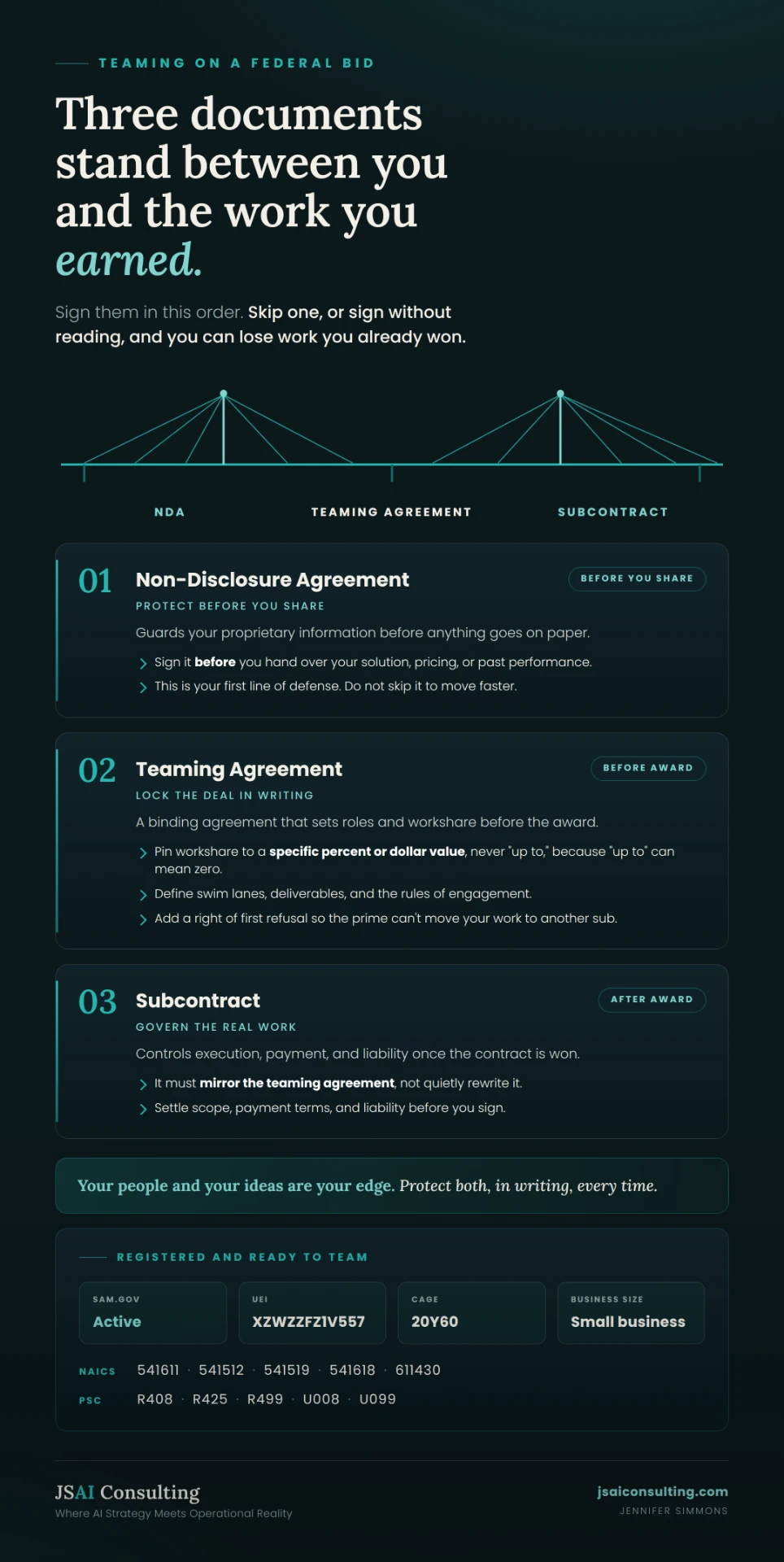
Before you share your solution, your pricing, or your past performance, get it signed. It protects you before anything goes on paper, and it is the one step people skip when they are trying to move fast.
It is binding, and it sets roles and workshare before the award. Pin your workshare to a specific percent or dollar value, never "up to," because "up to" can mean zero. Define the swim lanes, the deliverables, and the rules of engagement while everyone still needs each other.
Add a right of first refusal so the prime cannot quietly move your scope to another sub after the win.
It governs the money and the liability after the award, and it has to mirror the teaming agreement, not quietly rewrite it. Settle scope, payment terms, and liability before you sign, because this is the document that gets enforced when something goes wrong.
Your people and your ideas are your edge. Protect both, in writing, every time.
Looking for a teaming partner or a sub on an upcoming bid? JSAI Consulting is cleared for teaming and subcontracting (UEI XZWZZFZ1V557, CAGE 20Y60). If there is a fit on scope and timing, start with a conversation.
Schedule a Discovery CallNobody tells you that asking for training money is its own skill.
Here's the quiet contradiction in most AI upskilling right now: companies want everyone to learn it, and a lot of them expect you to do that for free, on your own time, with whatever self-paced course you find on your own.
Free and self-paced isn't wrong. It's just not universal. Some people learn best that way. Plenty of people don't, they need to ask a question out loud and get an answer back, or sit with other people wrestling the same material. There isn't one right track, there are three:
I paid for mine, out of my own pocket. Johns Hopkins, ten weeks, self-paced during the week and live mentored sessions with faculty and an actual cohort on the weekends. Worth every dollar, and not because the content was secret, most of it exists somewhere for free. It was worth it because I had people to ask when something didn't click and a room that expected me to show up.
Before you build your ask, know which track actually fits how you learn. Asking for a live cohort when you'd do fine self-paced, or the reverse, is how a good case gets a soft no.
Is the number you're asking for real, or is it the number you wish were real?
Knowing where the money comes from is only step one. Step two is making sure the ask can survive a second look.
Start here: can you afford to fund part of it yourself? Even a small co-investment signals you're serious and gives your manager an easier yes.
Then check it against a SMART goal, because "I want to learn AI" isn't a business case, it's a wish. Quick refresher if you need it:
If you can't fill in all five in one or two sentences, the ask isn't ready. That's not a failure, that's the goal doing its job. Go back, tighten it, come back.
Your training got approved. Now the real work starts.
You submitted the plan, it followed company policy, and you're on your way to the training you actually wanted. Most people stop there. The ones who get approved again next year don't.
No one is waiting until the end-of-year review anymore, not with budgets under this much scrutiny. Build your ROI story as you go, not the week before your check-in.
A simple way to track it:
The training was never really the ask. The ROI story is. That's the whole series in one sentence.
Enter the date your training starts (or started), and get four checkpoints, 30, 60, 90, and 120 days out, added straight to your calendar.
No one waits until the end of the year to see if training was worth it anymore. Enter the date your training starts (or started), and get four checkpoints, 30, 60, 90, and 120 days out, added straight to your calendar.
Already started? Use the date you began, the checkpoints will land wherever they land.
Everything above is yours to use, no strings attached. If you want the actual templates and business-case modules behind it, the ones that turn "I think this worked" into a documented case, that's what the Resource Library is for.
Full access to business-case modules and templates as they publish.
$16/month
Everything in the base library, plus a live weekly Saturday group Q&A call to work through the documents together and get real-time answers on your specific situation. For when a template isn't enough and you want to talk it through.
$60/month
Cancel anytime, no long-term commitment. Monthly plans stop billing the moment you cancel, the current month isn't refunded. Annual plans include a 14-day refund window from your purchase date, if it's not for you, email us within that window for a full refund. After 14 days, you can still cancel to stop future renewals, but the year you've paid for stands.
Once your payment is received, you'll get your download by email within one business day.
A short self-assessment worksheet to gut-check whether you're ready to make the ask.
The fill-in-the-blank version of the funding argument.
Turns the five-question checklist into something you actually fill out.
The document companion to the free calendar tool, something to hand your manager.
A short, persuasive memo template packaging the whole case into one page.
Turns your 120-day story into a reusable narrative.
Not ready to book? Get the starting checklist.
A short, practical checklist covering what to sort out first (readiness, guardrails, and the questions worth asking before anyone writes a plan). Sent by email, nothing else.
The framework above is free and it always will be. If you want someone to build your specific ask, run the numbers against your real budget, and walk it into the room with you, that's what a Discovery Call or the AI Strategy Session is for.
Follow along on LinkedIn for practical perspectives on AI, governance, and leading people through change.
Follow on LinkedInJSAI Consulting LLC is available for teaming and subcontracting across federal and mission-driven engagements.